The March That Changed the Stack
Physical AI, Thinner Control, Spatial Memory, TurboQuant, Code Modernization, and the Robotaxi Inflection
March 2026 did not politely announce itself. It detonated across every layer of the Physical AI stack—from silicon-level compression to embodied spatial cognition to the streets where robotaxis now compete for passengers—and confirmed several theses I have been advancing through the Un-Engineering lens for the past year.
This is not a news summary. It is a practitioner’s reckoning with what these advances actually mean for engineering organizations building autonomous systems, software-defined vehicles, and intelligent robotics at scale. The month delivered seven convergent disruptions that, taken together, redraw the boundary between demonstration-stage technology and deployable systems.
1. TurboQuant: The Compression Catalyst Physical AI Was Waiting For
Google’s TurboQuant paper dropped in March and it is, without exaggeration, the most consequential inference optimization I have seen since the quantization breakthroughs of 2024. The headline numbers are staggering: six times KV-cache memory reduction and up to eight times inference speedup—achieved through data-oblivious vector quantization that requires zero dataset-specific training.
Why does this matter for Physical AI? Because every autonomous system I work with—whether it is a software-defined vehicle running vision-language-action (VLA) models or a humanoid robot processing spatial context—is bottlenecked by inference memory on edge hardware. Today, an NVIDIA Jetson Orin running a 7B-parameter model with a 32K context window burns through its memory budget before the robot has finished a single room scan.
TurboQuant changes the math. A six-fold KV-cache compression means that same Orin can now sustain context windows exceeding 100K tokens at full accuracy—Google demonstrated needle-in-a-haystack retrieval at 104K tokens under 4x compression with zero degradation. For autonomous vehicles processing continuous sensor fusion, this is the difference between a system that forgets what happened 30 seconds ago and one that maintains persistent situational awareness across an entire drive.
The architectural elegance is worth noting: random rotation spreads information uniformly across vector dimensions, enabling independent per-dimension compression that approaches the theoretical optimum within 2.7x. Combined with the QJL transform for inner-product fidelity, this is not a blunt quantization hammer. It is a surgical compression framework that preserves the relational geometry models depend on.
If your autonomy stack runs on edge silicon, TurboQuant is not optional reading—it is your new inference baseline.
2. OpenClaw and Spatial Agent Memory: Robots That Remember the World
I wrote about OpenClaw’s spatial persistent memory capabilities several weeks ago, and March validated every thesis in that piece. The demonstration that went viral—a humanoid robot walking through a room while building a structured, queryable spatio-temporal model of its environment—is not incremental. It is a category shift in how robots relate to physical space.
Traditional robotic perception operates in present tense. Sensors fire, SLAM builds a map, the robot navigates, and context evaporates. OpenClaw’s spatial agent memory inverts this: every object, every person, every event is tagged with place, identity, and timestamp, stored as voxelized vector representations that persist across sessions. The robot does not just navigate a room—it accumulates a structured history of the physical world.
The implications for enterprise deployment are immediate. A warehouse robot that remembers where every pallet was placed three shifts ago. A factory inspector that tracks tool positions across weeks. An autonomous vehicle that recognizes a construction zone it encountered yesterday. This is the transition from reactive navigation to cognitive spatial intelligence, and it runs on the same OpenClaw framework that already powers software-agent workflows—meaning the tool-use, security-auditing, and orchestration infrastructure is mature, not bolted on.
The peaq SDK integration I flagged earlier enables these robots to generate decentralized machine identities—creating the foundation for a machine economy where autonomous systems transact, coordinate, and verify each other without human intermediation.
3. Thinner Control: Figure’s Helix and the Death of the Monolithic Policy
Figure AI’s Helix 0.2 demonstration—a humanoid autonomously cleaning a cluttered living room—was the most convincing whole-body manipulation demo I have seen from any company, period. But the real story is the control architecture, not the cleanup.
Helix operates on a three-tier hierarchy: System 2 (reasoning, scene understanding, behavior sequencing), System 1 (perception-to-joint-target conversion at 200Hz), and System 0 (balance, contact forces, body coordination at 1,000Hz). This is the kind of thin, disaggregated control stack I have been arguing for—where intelligence is layered, not monolithic, and each tier operates at its natural frequency.
The OmniXtreme framework from the Beijing Institute for General AI reinforces this direction. Their two-stage learning system—a unified base policy trained via DAgger-based flow matching, frozen, then refined with a residual policy under motor constraints—achieved 90%+ success rates across extreme dynamic tasks on a single algorithm. No per-skill retraining. No policy explosion. This is how you scale embodied AI: train the foundation once, specialize the residual.
Meanwhile, KAIST’s humanoid V0.7 demonstrated running at 12 km/h and stair climbing using proprioception alone—no camera dependency for terrain adaptation. Their motor operating region modeling ensures simulation-to-real transfer fidelity. When combined with their DoFlow framework for learning from human demonstrations, this points toward a world where robotic control is both thinner and more robust.
4. The FCC Router Ban and the AI Code Modernization Imperative
On March 23, the FCC dropped a regulatory bombshell that most AI commentators missed entirely: all foreign-manufactured consumer routers are now banned from receiving new FCC authorization, effectively blocking imports from every major manufacturer—TP-Link, Netgear, ASUS, Google Nest, Amazon Eero—since virtually none are manufactured domestically. The security rationale is real: Salt Typhoon, Volt Typhoon, and Flax Typhoon demonstrated that compromised router firmware is a direct attack vector into American critical infrastructure.
But the Un-Engineering angle is what matters here. This ban does not just disrupt supply chains—it forces a massive code modernization event. The router industry runs on decades of legacy C and C++ firmware, much of it written for proprietary chipsets with opaque binary blobs. If domestic manufacturing is to fill the gap (and the ban leaves no alternative), that firmware must be audited, refactored, and in many cases rewritten for new hardware platforms—at a scale and speed that manual engineering cannot deliver.
This is precisely where AI-based code modernization becomes not a nice-to-have but an operational necessity. The same LLM-powered code migration pipelines we have been building at Wipro for enterprise legacy systems—translating COBOL to Java, AUTOSAR Classic to Adaptive, PLC ladder logic to structured text—now have a massive new addressable market in embedded systems firmware.
Consider the engineering challenge: millions of lines of C code written for MediaTek, Qualcomm, and Broadcom chipsets must be analyzed for security vulnerabilities (the entire premise of the ban), then migrated or refactored for domestic fabrication targets. Mistral’s LeanStral is directly relevant here: a 6B-parameter model that can formally verify migrated code at ~$36 per verification cycle versus $1,000+ for alternatives. Combine that with AI-powered static analysis, automated test generation, and continuous formal verification, and you have a scalable pipeline for what would otherwise be a multi-year, multi-billion-dollar manual effort.
The broader pattern is clear: regulatory mandates—whether FCC router bans, EU Cyber Resilience Act compliance, or automotive UNECE R155/R156 cybersecurity regulations—are creating forcing functions for AI-assisted code modernization at industrial scale. Organizations that have already invested in these capabilities will capture enormous value. Those that haven’t will face existential timelines.
The FCC didn’t just ban routers. It created the largest forced firmware modernization event in the history of consumer electronics—and AI is the only tool that can meet the deadline.
5. Factory Floor Reality: Humanoids Cross the Deployment Threshold
March was the month humanoid robotics stopped being a demo reel and started becoming an industry. The evidence is stacking:
Agibot G2 running 270 TOPS on NVIDIA Jetson Thor, with 26 degrees of freedom and 7-DOF arms capable of 0.5N precision—assembling automotive components and learning RAM insertion in one hour of training. BMW Leipzig deploying Aon humanoids for battery assembly using Isaac Sim/Lab for simulation-first training, targeting NVIDIA IGX Thor upgrades. Xiaomi achieving 90.2% success rates on its EV production line with a 4.7B-parameter VLA model, completing assembly cycles in 76 seconds. UBTECH signing with Siemens for digital manufacturing infrastructure to scale to 10,000 units/year, backed by 1.4 billion yuan in 2025 orders.
This is the industrialization thesis I have been building at Wipro: the three customer segments—robotic OEMs, enterprises deploying robots, manufacturers pursuing autonomous production—are all activating simultaneously. The companies that win will not be the ones with the most impressive demo. They will be the ones with the digital manufacturing backbone, simulation-first training pipelines, and edge inference efficiency to produce and deploy at scale.
6. The Robotaxi Inflection: From Science Project to Street-Level Competition
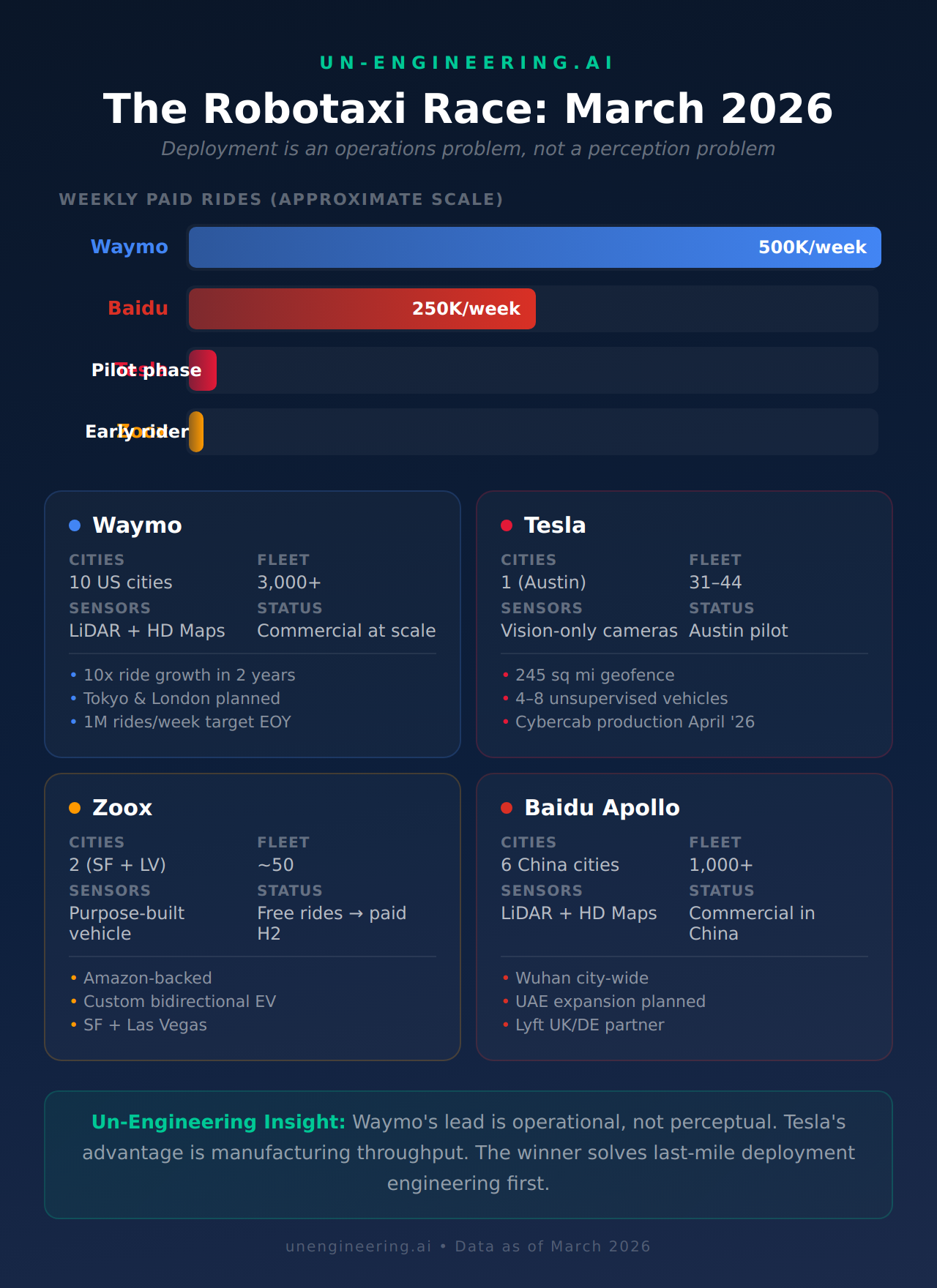
While factory humanoids made headlines in China, the autonomous vehicle space hit an undeniable inflection point on American streets. Waymo crossed 500,000 paid robotaxi rides per week across 10 U.S. cities in March—a tenfold increase from 50,000 weekly rides just two years ago—and is targeting 1 million weekly rides by year-end. The company expanded into Miami, Dallas, Houston, San Antonio, and Orlando, with international launches planned for Tokyo and London.
Tesla, meanwhile, expanded its unsupervised robotaxi geofence in Austin to roughly 245 square miles—twelve times the original footprint—but the reality behind the map tells a different story: somewhere between 4 and 8 vehicles are actually operating without a human safety monitor, all under remote supervision. Cybercab production is slated for April 2026, and Musk projects expansion to 30+ cities, but the operational gap with Waymo remains vast.
From an Un-Engineering perspective, this divergence is instructive. Waymo’s approach—LiDAR-rich sensor fusion, HD map localization, and a 3,000+ vehicle fleet—represents the classic systems engineering playbook: validated hardware, known operating domains, incremental expansion. Tesla’s vision-only approach bets on scale through data—6.9 billion miles of supervised FSD telemetry training a camera-only perception stack that, in theory, scales to every Tesla on the road.
Neither approach is wrong. But the lesson for Physical AI practitioners is that the gap between demonstration and deployment is a manufacturing and operations problem, not a perception problem. Waymo’s lead comes from fleet operations, city-by-city regulatory relationships, and utilization optimization—not from having fundamentally better AI. Tesla’s advantage is vertical integration and manufacturing throughput. The winner will be decided by who solves the last mile of deployment engineering faster.
Zoox is entering with purpose-built vehicles in San Francisco and Las Vegas. Baidu’s Apollo Go passed 250,000 weekly rides in China, with expansion to Abu Dhabi and the UAE. And Uber is preparing an “Uber-exclusive robotaxi” with Lucid Motors and Nuro for late 2026. The competitive landscape is no longer theoretical—it is a multi-player, multi-geography, real-revenue business.
If your autonomy stack works in Bengaluru traffic, it works anywhere. March proved that the world’s streets—and factory floors—are ready to test that proposition.
7. The Un-Engineering Thesis: Convergence Is the Product
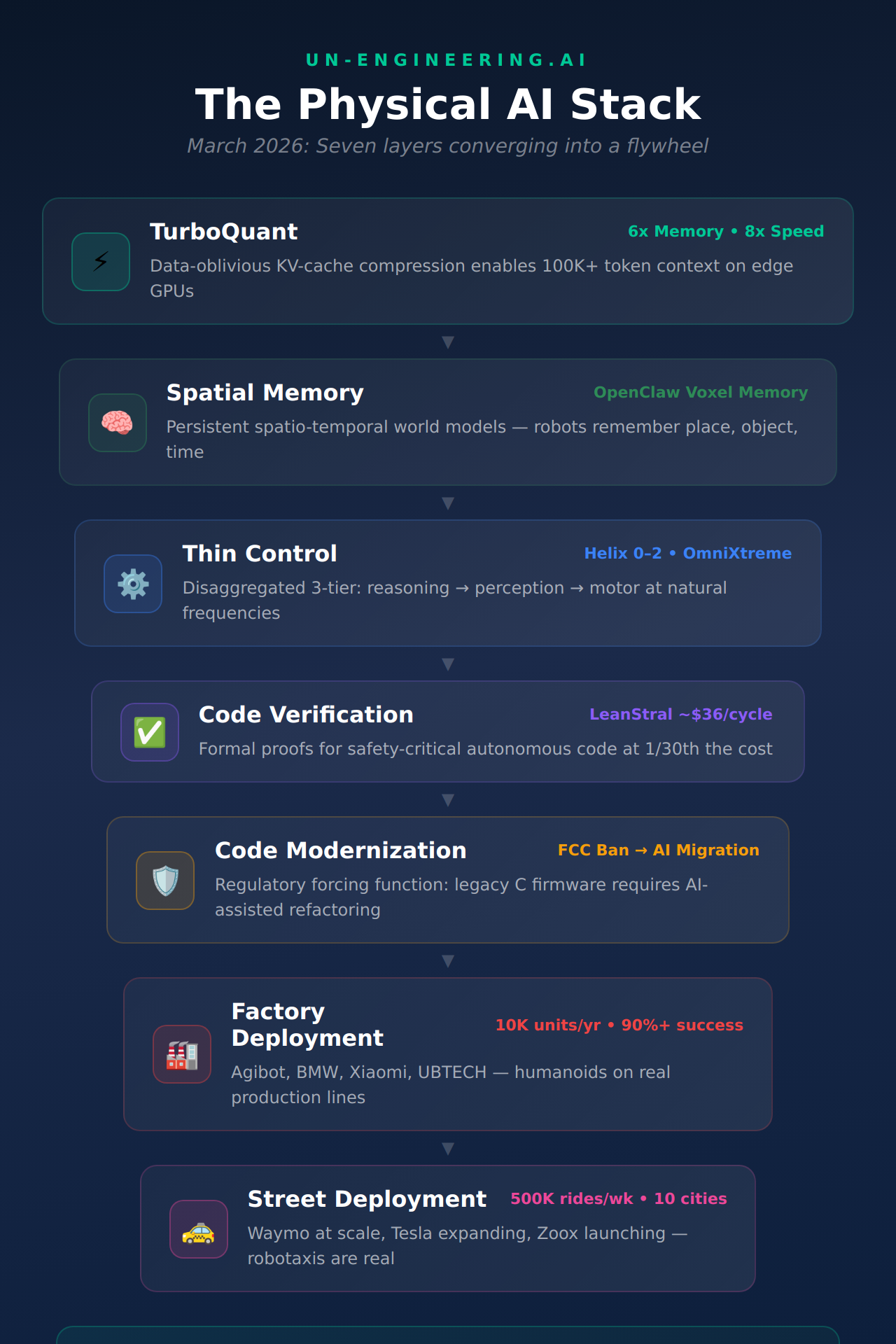
What makes March 2026 different from any prior month in Physical AI is not any single announcement. It is the convergence. TurboQuant makes edge inference viable for persistent spatial memory. Spatial agent memory makes thin control architectures more effective. Thin control makes formal verification tractable. Formal verification makes factory deployment certifiable. The FCC ban creates a regulatory forcing function for AI code modernization at industrial scale. And on the streets, robotaxis are proving that autonomous deployment is an operations and manufacturing challenge, not a perception moonshot.
This is not a linear progression. It is a flywheel, and March was the month it started spinning visibly.
For engineering leaders: stop evaluating these technologies in isolation. The competitive advantage belongs to organizations that integrate across the stack—from compression to cognition to certification to production to street-level deployment.
The robots are not coming. They shipped in March.