The 3D-IC Power Crisis: Solving the AI Scaling Bottleneck at the Silicon Level
High-density 3D-IC architectures are becoming essential for AI scaling, but they present unprecedented challenges in power integrity and delivery.
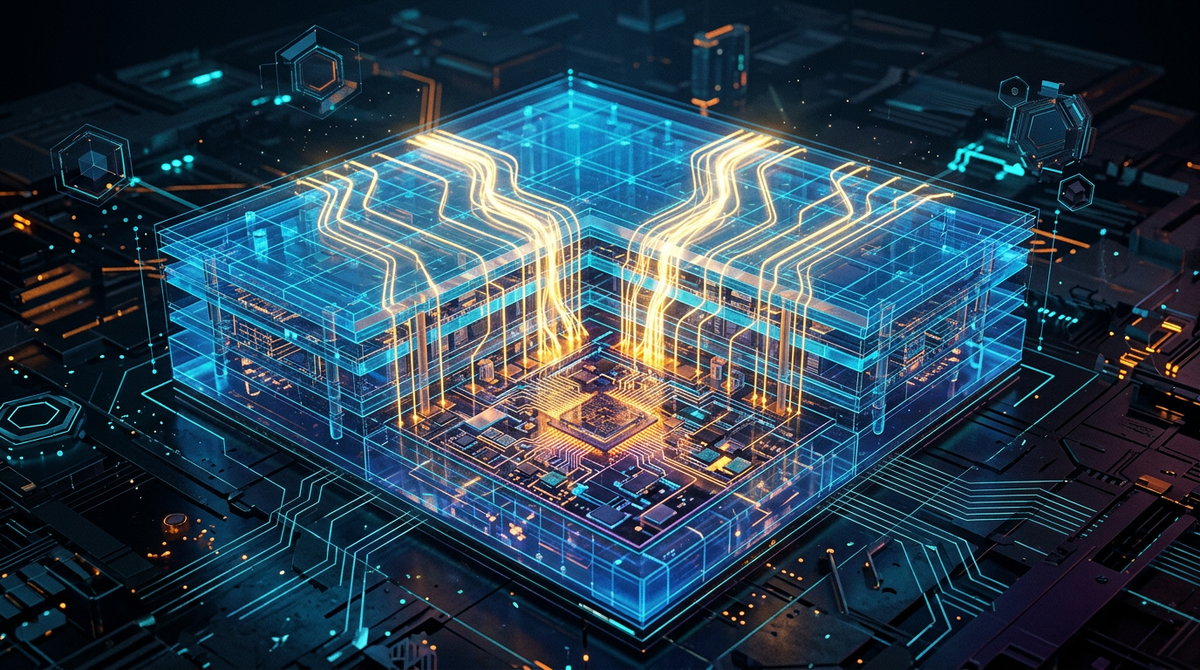
As AI models grow exponentially, the physical limits of two-dimensional semiconductors are being reached. The industry’s answer is 3D-IC—stacking chips vertically to increase interconnect density and reduce signal latency. However, as 3D-ICs become the standard for high-performance AI hardware, a new bottleneck has emerged: power integrity.
Powering a 3D stack is significantly more complex than a planar chip. Engineers must route electricity through vertical "vias" (TSVs) to reach upper layers, creating heat hotspots and voltage drops that can destabilize the entire system. Without precise power delivery, the performance gains of 3D-ICs are countered by the "thermal throttling" required to keep the chip from melting.
The semiconductor ecosystem is now forced to innovate at the package level, developing new materials and architectures for power delivery. Solving these power integrity issues is the "hidden" engineering challenge of the AI boom. Without a breakthrough in how we move energy through these dense silicon towers, the hardware side of generative AI may hit a hard physical ceiling.
Source: Semiconductor Engineering