The New Front Line: How Drones and Distributed Sensors are Redefining Warfare
Ukraine's successful drone onslaught against the Kerch Bridge underscores the new reality of AI-driven warfare. As cheap drones become lethal precision weapons, the US military is racing to deploy tactical sensors and concrete hardening.
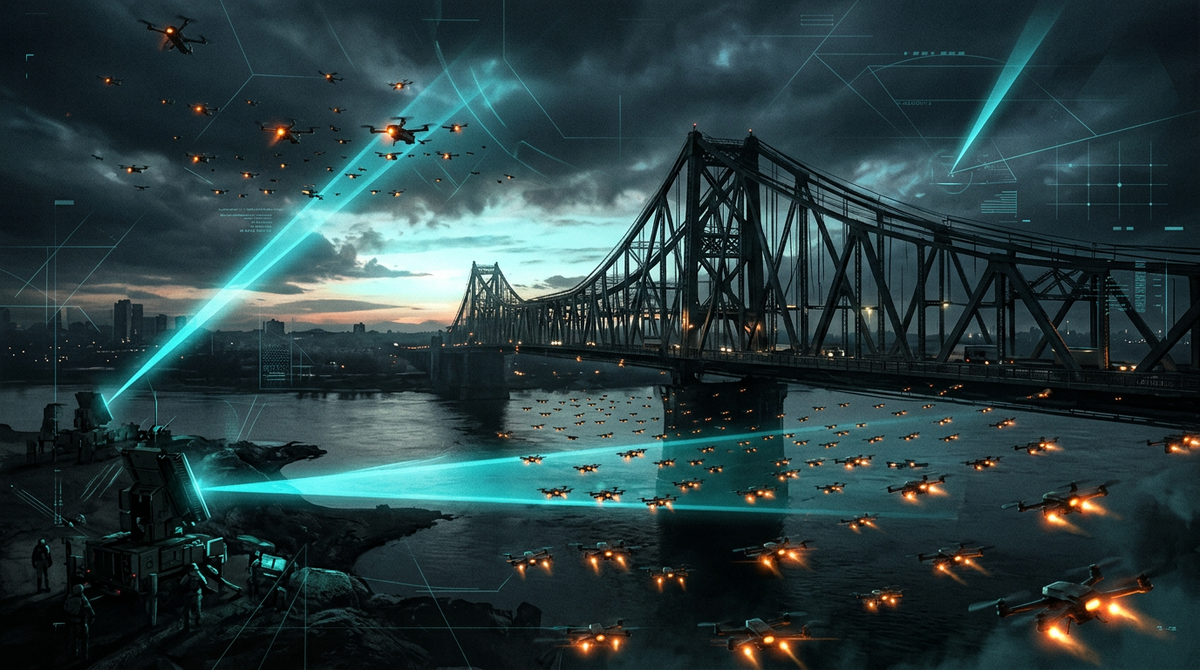
The conflict in Ukraine continues to serve as a laboratory for Neo-Defense tech, most recently with a massive drone onslaught that successfully disabled a span of the Kerch Strait Bridge. This event highlights a paradigm shift: strategic, multi-billion dollar infrastructure can now be crippled by swarms of relatively inexpensive, autonomous, or semi-autonomous munitions. The 'democratization' of precision strike capability is forcing modern militaries to rethink everything from logistics to troop protection.
In response, the U.S. Army is shifting its focus toward 'hardening' and distributed sensing. The era of the 'exquisite' large-scale radar is ending, as these high-signature assets become primary targets for anti-radiation drones. Instead, the focus is moving toward smaller, tactical sensors that can be distributed across a battlefield to create a resilient mesh network. Simultaneously, the Pentagon is returning to basics, seeking concrete bunkers for troops in high-risk zones like Israel and Lebanon, acknowledging that electronic warfare alone cannot stop a physical swarm.
The rise of the 'Counter-UAS' (Unmanned Aerial Systems) industry is the logical byproduct of this threat. New systems are being developed that use AI to help soldiers 'gun down' incoming drones with traditional kinetic rounds or truck-mounted lasers. As we enter the age of 'Robot Wars,' the winner will not necessarily be the one with the most expensive jets, but the one who can best integrate autonomous systems with resilient, low-cost defense infrastructure.
Source: The Drive / TWZ