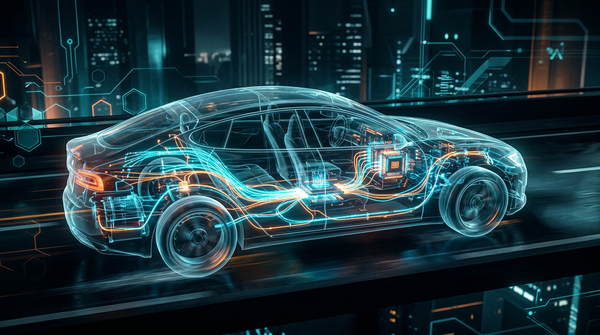
The Memory Backbone of SDVs: Why LPDDR is Moving from Phones to Cars
As vehicles transition to software-defined architectures, the demand for energy-efficient, high-bandwidth memory at the edge is skyrocketing. LPDDR memory, once a smartphone staple, is now the backbone of real-time automotive inference.

The Software-Defined Vehicle (SDV) is no longer a concept; it is a hardware reality that demands a radical rethinking of memory architecture. Traditionally, automotive memory focused on durability and long lifecycles. However, the rise of agentic AI within the cockpit—handling everything from natural language interfaces to complex sensor fusion—requires the high-performance throughput usually found in premium smartphones. This has paved the way for the massive expansion of LPDDR (Low-Power Double Data Rate) memory into edge AI platforms.
LPDDR is uniquely suited for the SDV era because of its balance between power efficiency and thermal management. In an electric vehicle, every watt consumed by the compute platform is a watt taken away from the driving range. Real-time on-device inference, required for low-latency feedback in software-defined cabins, benefits from LPDDR’s ability to move large datasets quickly while staying within the strict thermal envelopes of a vehicle's dashboard.
Furthermore, as automakers move toward centralized compute architectures—where a single powerful "brain" controls multiple vehicle functions—the ability to scale memory becomes paramount. The transition to LPDDR5X and beyond ensures that the SDVs of tomorrow have the "working memory" necessary to support continuous over-the-air (OTA) updates, allowing vehicles to gain new features and improved AI capabilities long after they leave the dealership.
Source: Semiconductor Engineering