The End of Copper: Why AI Factories Are Moving to Optical and 800V DC
As AI clusters expand, traditional copper interconnects are reaching their physical limits. The industry is pivoting toward 800V DC power architectures and optical interconnects to sustain the massive compute requirements of next-gen AI factories.
Scaling AI performance is no longer just a challenge of designing better silicon; it is now a challenge of physics and infrastructure. As NVIDIA and its partners aim to mobilize over $500 billion for "AI Factories," the semiconductor industry is hitting a wall with traditional power and data distribution methods. At the heart of this transition is the '1-Megawatt Rack' debate, where engineers are questioning how to deliver enough power to a single server rack without melting the components.
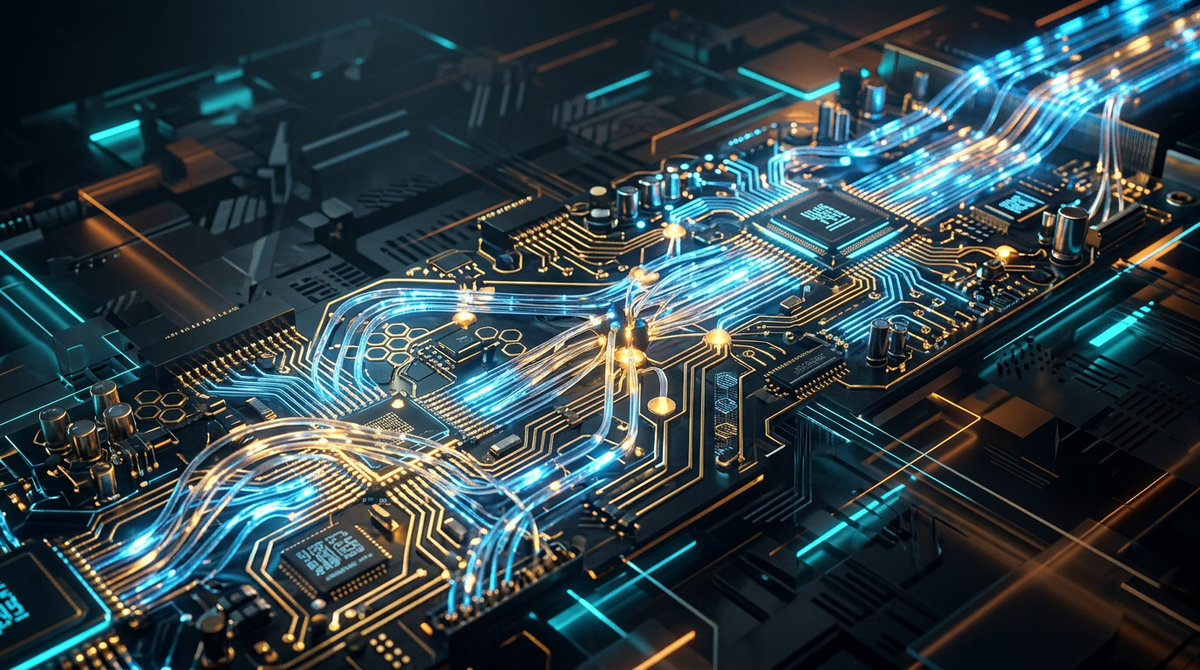
One of the most significant shifts is the move from AC to 800V DC power architectures. By increasing the voltage, data centers can reduce the current—and thus the heat generated—while delivering the massive amounts of energy required by Blackwell-class GPUs. Furthermore, the industry is seeing "copper’s grip" on scaling start to slip. Traditional copper cables are becoming too bulky and signal-limited to handle the bandwidth required for massive AI clusters, leading to a surge in optical interconnect and silicon photonics adoption.
Vertical integration is also becoming pervasive. To optimize these systems, hardware and software must be co-designed from the ground up. This means semiconductor firms are working directly with power engineers and data center architects to rethink the entire stack. From DDR5 9600 RDIMMs that raise the memory benchmark to self-verifying agentic EDA workflows, the goal is clear: maximize the "compute per watt" ratio. As we push toward the next order of magnitude in AI training, the innovations in power and connectivity will be just as critical as the number of transistors on the chip.
Source: Semiconductor Engineering