Ship the Sensors, Not the Option
The software-defined vehicle doesn’t die in the lab. It dies in the spreadsheet — the moment a CFO turns the sensing-and-compute stack into an upsell.
We keep debating the software-defined vehicle as a software problem. Zonal architecture. A unified vehicle OS. Secure OTA. Containerised middleware. All of it real, all of it necessary — and all of it a distraction from the decision that actually determines who wins.
The fundamental inhibitor to SDV success is not software. It is a hardware decision dressed up as a finance decision, made years before the “software-defined” stack ever ships: the refusal to put a high-performance compute node and a common sensing stack in every vehicle, regardless of whether the buyer ticks the box for the driver-assistance package.
Skip that, and there is no fleet-wide data generation. No data flywheel. And without the flywheel, no defensible path to L2++ ADAS — let alone autonomy, or the option to convert your installed base into a robotaxi resource later. You cannot software-define your way out of a hardware-acquisition decision you declined to make.
The starved loop
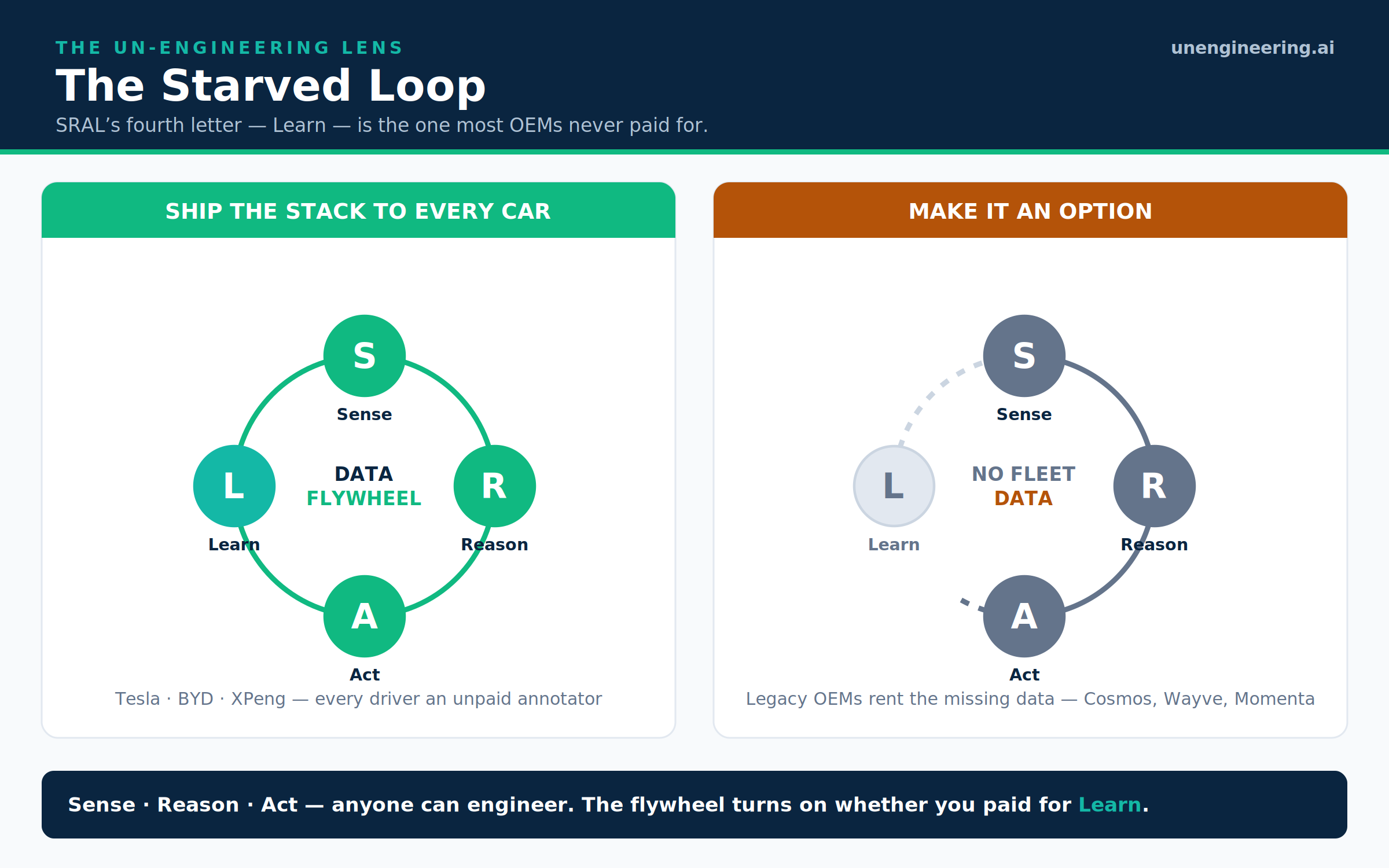
Run it through SRAL — Sense, Reason, Act, Learn. The industry is genuinely good at the first three. Sense the world, reason about it, act on it: that is classic automotive V-model engineering, and OEMs have a century of muscle memory for it. The fourth letter is the one they starve. Learn is not an algorithm you license; it is a loop you have to feed, and the loop only closes if the Sense hardware is already in the cars — all of them, in the wild, every day.
That is the whole game. Learning at fleet scale is not a software feature. It is the consequence of a hardware decision you either made or you didn’t.
What Tesla actually did
The Tesla insight is routinely mis-told as a software or chip story. It was a deployment decision. From Model 3 in 2017, Tesla shipped the full camera suite and the FSD computer in every car built — decoupled entirely from whether the buyer paid for Full Self-Driving. Overnight, every driver became an unpaid, real-world data annotator.
The mechanism is Shadow Mode: the autonomy stack runs passively in the background, predicting what it would do while the human drives. The human’s action is the answer key. When the model disagrees with the human in a way that matters, that clip — and only that clip — is flagged and uploaded. Auto-labelling turns millions of these high-entropy needles into training data with no human in the loop; OTA pushes the improved policy back out.
The genius was never the model. It was that the cost of data acquisition was amortised into the bill of materials once, per car — and then compounded for free, across millions of vehicles, forever. Tesla does not pay its drivers for the most valuable dataset in mobility. The hardware decision made the data free.
A playbook, not Tesla magic
The tell that this is repeatable — not some Musk-specific alchemy — is that the Chinese OEMs ran the exact same play and it worked. In February 2025, BYD launched “Intelligent Driving for All” and put its God’s Eye stack into nearly the entire lineup as standard, at no extra charge — all the way down to the roughly $9,550 Seagull. By November 2025, more than 2.3 million God’s Eye vehicles were on the road, generating on the order of 150 million kilometres of assisted-driving data every single day.
BYD didn’t sell ADAS as a margin-rich option. It turned mass-produced cars into moving data-collection terminals. XPeng learned the same lesson the hard way: it tried to charge separately for its driver-assistance features, watched demand stay flat, abandoned the paywall in 2022, and made the capability standard. NIO and Li Auto followed the same logic. They all understood that the strategic asset was never the feature. It was the fleet.
The cautionary tale — and the trap inside it
Now the contrast. The “rational” move — the one that survives a quarterly margin review — is to gate the sensor-and-compute stack behind a premium trim or an optional package, to protect unit economics. It optimises the wrong variable, and it fragments the fleet at exactly the wrong layer: the cars that could generate the richest data are precisely the ones shipped without the hardware to do it. The flywheel never reaches escape velocity.
And the systems that do ship, selectively, are narrow by construction. GM’s Super Cruise and Ford’s BlueCruise are map-anchored — hands-free only on pre-mapped, geofenced highways (Super Cruise on roughly 750,000 LiDAR-mapped miles; BlueCruise inside its “Blue Zones”). They cannot navigate point-to-point through a city. They lean on an infrared driver-monitoring camera that nags when your gaze drifts. Within their narrow operational domain they are competent — Super Cruise has a strong safety record — but narrow is the ceiling, because there is no flywheel underneath to widen it.
Here is where the finance logic quietly eats itself. The entire SDV business case rests on recurring software revenue. But a roughly $40-a-month Super Cruise subscription is a hard sell when the system only works on mapped highways and improves slowly, because nothing is feeding it. Tesla can charge for FSD precisely because the fleet makes it visibly better month over month. BYD gives urban navigation away for free, collapsing willingness-to-pay for any narrow Western alternative. Weak system, low willingness to pay, no recurring revenue, no business case to ship the hardware fleet-wide, no data — and the system stays weak. It is the flywheel run in reverse. The optional-hardware decision doesn’t protect the subscription business. It strangles it in the cradle.
The escape hatch that’s really a tax
Faced with a self-inflicted data deficit, the laggards reach for two things. First, synthetic data from neural-reconstruction world models — NVIDIA Cosmos (Transfer and Predict 2.5, Reason 2, and now the unified Cosmos 3 omni-model unveiled at COMPUTEX in June 2026), feeding VLA driving stacks like NVIDIA’s Alpamayo, a 10-billion-parameter chain-of-thought vision-language-action model built on Cosmos-Reason and a diffusion trajectory decoder. Second, licensing a driving brain outright from software players like Wayve (AV2.0, an $8.6B valuation, Mercedes-Benz, Nissan and Stellantis on the cap table) or Momenta (whose model is literally branded “Flywheel,” trained on three-billion-plus kilometres of real data).
This is genuinely excellent technology. But watch what it does to the economics and the moat. Start with the number everyone gets wrong: synthetic data is cheaper per clip than real-world collection — on the order of $1 to $1.50 for a ten-second generated clip, perhaps $10–15K for ten thousand of them, against roughly $500K for an equivalent real-world dataset. So “simulation is too expensive” is the wrong critique. The right critique is structural. Sim converts a one-time CapEx-per-vehicle — sensors in the BOM — into a perpetual cloud OpEx: a data tax you pay every quarter, indefinitely, to someone else’s GPUs and someone else’s foundation model.
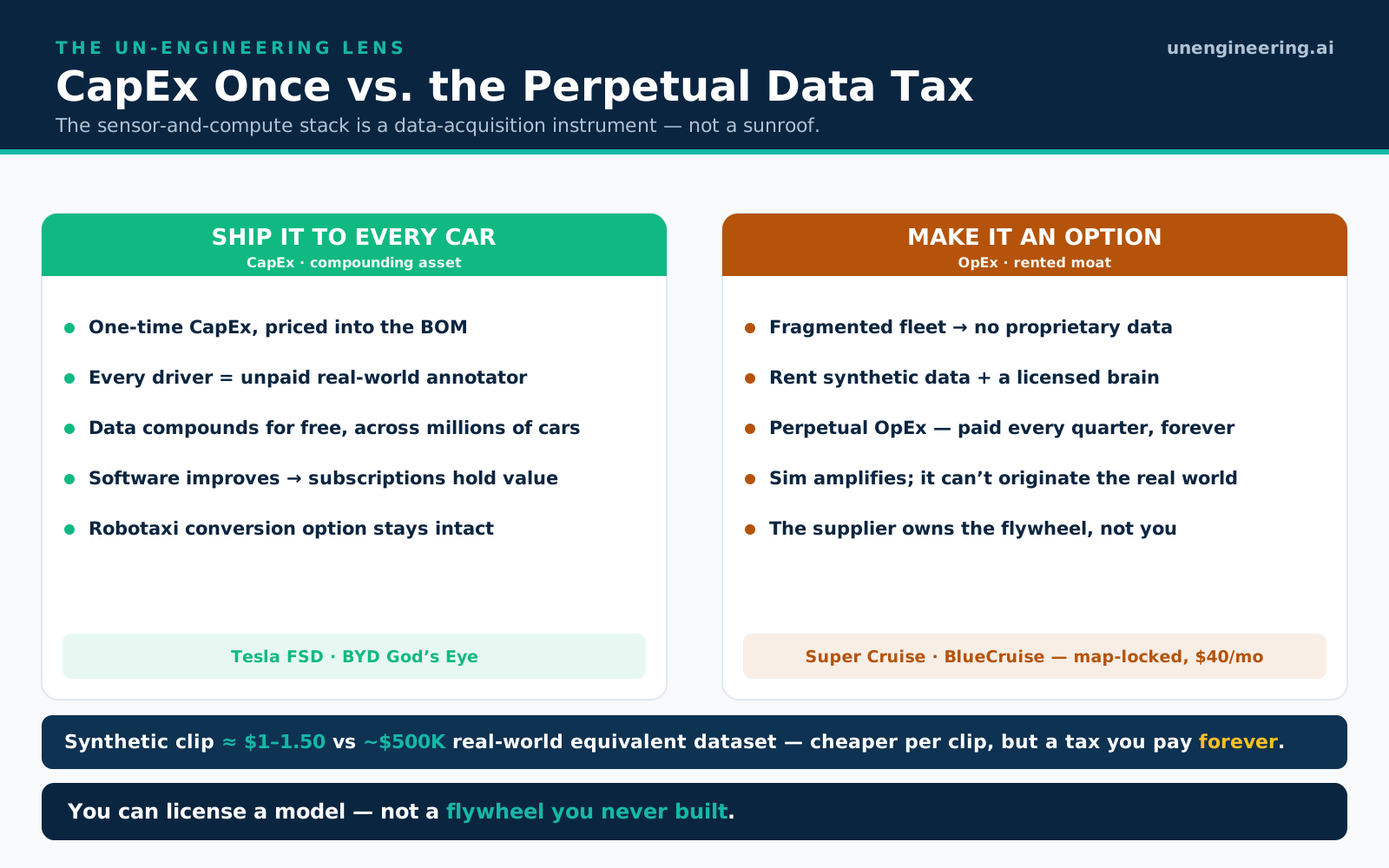
And it can only ever be a multiplier on real data, not a substitute for it. Synthetic generation amplifies a distribution you already captured; it cannot originate the real-world distribution, or surface the unknown-unknowns, that only a deployed fleet produces. Even Alpamayo’s reasoning is grounded in 1,727 hours of real driving from 25 countries, plus human-in-the-loop causal labelling. Wrong distribution in, confident nonsense out.
Then the part that should keep a strategy office awake: the flywheel you feed by licensing Wayve or Momenta is not yours. “Every mile driven strengthens the system for every vehicle running our software,” Wayve says plainly — meaning the compounding data moat accrues to the supplier, pooled across all of its OEM customers. The automaker that skipped the hardware ends up a hardware shell, renting a shared brain, handing the one strategic asset the SDV era was supposed to create to a vendor.
You can license a model. You cannot license a flywheel you never built — you can only spin someone else’s.
The un-engineering reframe
This is a hundred-year-old business model misapplied to a new kind of object. Trim-and-options feature-gating made perfect sense when a sunroof was a sunroof: a discrete cost, recovered at the point of sale, end of story. The sensor-and-compute stack is not a sunroof. It is a data-acquisition instrument. Gate it by trim and you optimise unit margin while destroying the compounding asset. The CFO is solving the right equation for the wrong object.
To un-engineer the SDV is to delete the inherited assumption that the hardware is a feature to upsell, and install the assumption that it is infrastructure to amortise — priced into every car, monetised later through software that the fleet’s own data makes good enough to charge for.
There is a final asymmetry worth naming. A fleet with uniform compute and sensing is a standing call option — on autonomy, and on robotaxi conversion. Every car is a potential earning asset and a validation node. A fragmented fleet holds no such option, and you cannot retroactively install a flywheel into cars that were built blind. Tesla’s robotaxi thesis, BYD’s, the Wayve–Uber model — all of them assume uniform hardware as the substrate. The OEMs that made the sensors optional didn’t merely defer a data strategy. They wrote off the option value of their own installed base, and booked it as margin.
Sense, Reason, Act — the industry can engineer all three in its sleep. Whether the software-defined vehicle pays off comes down to a single, unglamorous decision made years earlier: were you willing to pay for the Learn? Most weren’t. That, not the software, is why the SDV is stuck.