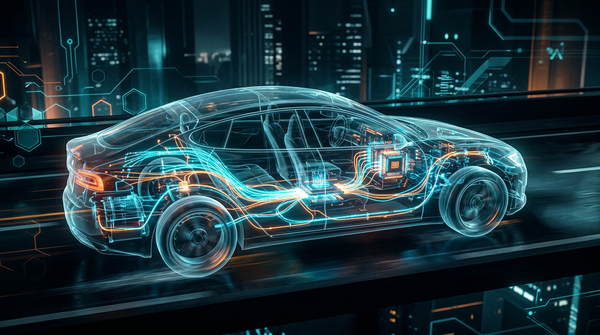
Predictive Perception: How Next-Gen ADAS Learns to Feel the Road
As Level 2 and Level 3 autonomy become standard, the integration of advanced sensors and real-time edge processing is redefining vehicle safety and driver assistance.

The distinction between simple driver assistance and full autonomy is blurring, thanks to the rapid evolution of Advanced Driver Assistance Systems (ADAS). Current projections suggest that by 2035, the installed base of Level 3-5 vehicles will reach nearly 50 million. However, the immediate impact is being felt in the refinement of Level 2+ systems, which now utilize sophisticated sensor fusion to provide unprecedented safety margins.
Modern ADAS is moving beyond basic lane-keep assist. Today’s systems are leveraging "General Intuition"—foundation models trained to understand how objects move through space and time. By utilizing high-fidelity training data, often sourced from simulated environments or even video games, these systems are learning to "feel" and "predict" the road environment. This enables the vehicle to anticipate hazardous maneuvers by other drivers before they occur.
The push for safer ADAS is also driving a revolution in tactile sensing. Researchers are working to give vehicles a "sense of touch" through advanced telemetry, allowing the system to detect micro-vibrations and changes in road friction. This level of granular data is essential for maintaining safety in adverse weather conditions, ensuring that the ADAS can respond to a slick road surface faster than a human operator could ever perceive the danger.
Source: IEEE Spectrum