Naval Autonomy Escalates as U.S. Navy Launches RASWDC and China Builds UUV Mothership
The U.S. Navy has established the Robotics and Autonomous Systems Warfighting Development Center (RASWDC) to integrate unmanned systems. Concurrently, satellite imagery reveals China is constructing a dedicated mothership for large uncrewed submarines.
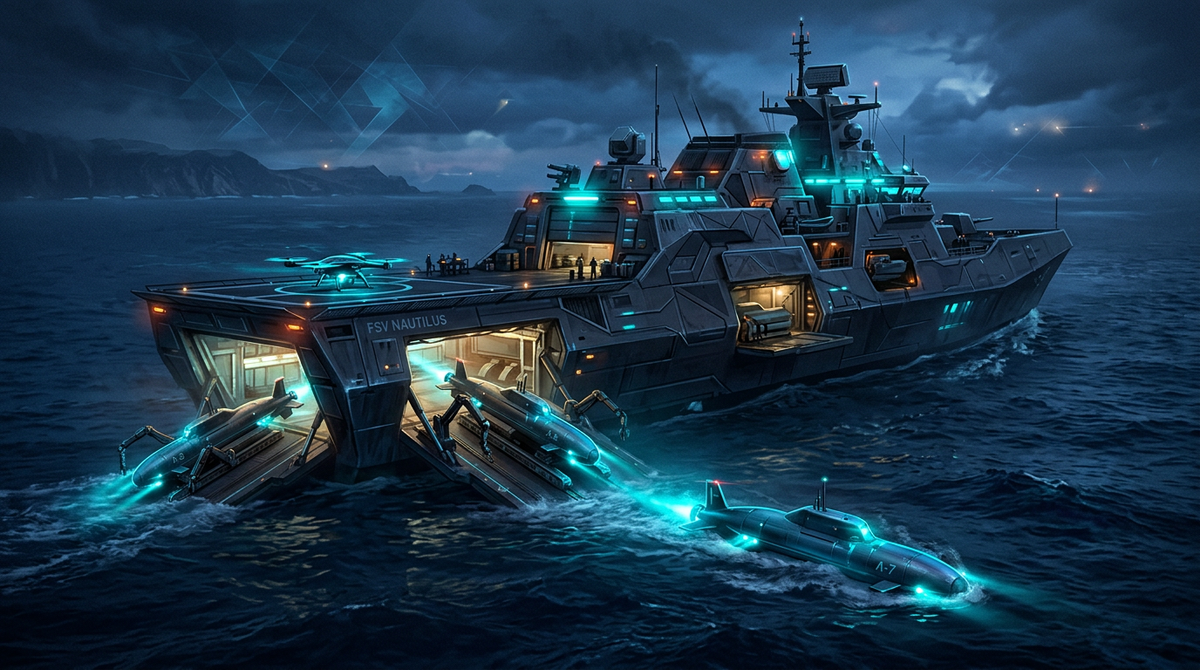
The naval warfare landscape is experiencing a rapid technological evolution centered on uncrewed systems and autonomous platforms. In a strategic move to formalize these capabilities, the U.S. Navy has launched the Robotics and Autonomous Systems Warfighting Development Center (RASWDC). This new command is tasked with formulating operational doctrines, establishing command-and-control frameworks, and streamlining resource requirements to fully integrate autonomous surface, subsurface, and aerial drones into carrier strike groups and fleet operations.
Simultaneously, near-peer competitor nations are advancing their own uncrewed naval technologies. Recent satellite imagery indicates that China is constructing a highly specialized, massive mothership designed specifically to deploy and recover large uncrewed underwater vehicles (UUVs). The vessel features a distinct open stern, structural launching cradles, and specialized sub-surface deployment mechanisms. This dedicated naval asset points to a long-term strategy aimed at sustaining long-endurance, autonomous submarine operations in contested waters without risking manned surface vessels.
These parallel advancements underscore a broader shift toward algorithmic and robotic warfare at sea. As both nations accelerate the production of autonomous systems, the strategic focus is moving away from traditional tonnage toward the scalability and deployment speed of distributed, uncrewed networks. For the U.S. Navy and its allies, maintaining a technological edge will depend on RASWDC’s ability to field reliable autonomous systems that can communicate, adapt, and operate cohesively in heavily contested electronic warfare environments.
Source: Breaking Defense