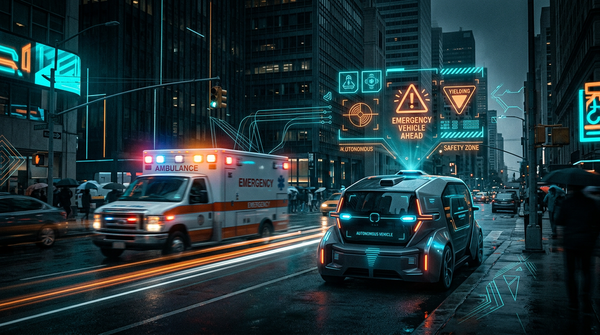
NHTSA Mandates Improved First Responder Detection for AVs
NHTSA warns autonomous vehicle companies that emergency scenes are not 'edge cases.' New mandates require ADAS and AV systems to better recognize and yield to first responders.
Feds to AV Makers: Emergency Scenes Are Not Edge Cases
The National Highway Traffic Safety Administration (NHTSA) is drawing a hard line in the pavement regarding how Advanced Driver Assistance Systems (ADAS) and fully autonomous vehicles interact with emergency services. In a stern demand to the industry, federal regulators clarified that encountering first responders, flares, and emergency lighting is a core part of driving, not a rare "edge case" that can be deprioritized in software development.
The mandate comes after several high-profile incidents where vehicles equipped with ADAS or autonomous software failed to recognize stationary emergency vehicles or drove through active crime scenes. The Feds are now demanding that these systems be designed with a higher degree of sensitivity to the visual and auditory cues of first responders. This includes the ability to distinguish between standard traffic lights and the strobing blues and reds of a police cruiser, as well as recognizing hand signals from officers directing traffic.
For the ADAS industry, this means a shift in validation priorities. Engineers must now prove that their systems can safely navigate the chaotic, unpredictable environments of a crash site. Failure to meet these standards could lead to stricter oversight and potential bans on certain features until they can be proven safe. As ADAS technology becomes standard in consumer vehicles, the ability to "see" and "respect" the heroes of the road is no longer optional—it is a regulatory necessity.
Source: TechCrunch